


Can’t do trail work?
Donate to FBT instead. “We appreciate that the Wyoming Range 100 allows its runners to donate to FBT if they’re unable to do their 8 hours of trail work,” says FBT executive director Scott Kosiba. “The BTNF is vast and so are its needs. We’re happy to be in a position to leverage donations into stewardship of this special place.”
Similar to many ultramarathons, the Wyoming Range 100 includes a service component—eight hours of trail work. “It has been a requirement from day one,” says run founder Denis Cook. “And we made the decision that you can’t volunteer at another race to satisfy this requirement. Given how rough the trails are that the Wyoming Range 100 is on, we wanted to make sure runners were boots on the ground with actual trail work.” Runners local to the BTNF are encouraged to do their volunteer trail work on the BTNF.
But, recognizing that not all runners have the opportunity local to them to do volunteer trail work, the run allows participants to make an $80 donation to FBT in lieu of it. “We chose to support Friends of the Bridger-Teton because of the work they do on and around the course—investing in the public lands that make the Wyoming Range 100 possible,” says Cook.
Founded in 2019, Friends of the Bridger-Teton works across all six districts of the BTNF to support the national forest and its dedicated staff. The BTNF is the third largest national forest in the continental U.S. It has more than 2,500 miles of trails for hiking, biking, UTVs, snowmobiling, and horses. Within it are six different mountain ranges, three wilderness areas, and the headwaters of three of the West’s major rivers.
“2025 was a year of big change for the Bridger-Teton National Forest,” said Todd Stiles, district ranger of the BTNF’s Jackson District. “Friends of Bridger-Teton was there to help with our staffing, budget, and logistical challenges as the year evolved. At every turn, they were providing ideas and flexibilities to help us maintain our key programs. If I had to sum it up in a few words, simply put, they were there for the employees of BTNF when we needed them.”
Help FBT continue its work supporting the land, staff, and many uses of the BTNF.
The Wyoming Range 100 takes place on the BTNF’s Big Piney and Greys River Districts.

Big Piney District
About 449,000 acres in size, this district has about 300 miles of trails. The Wyoming Range 100 ascends its tallest peak, 11,383-foot Wyoming Peak.
In addition to being home to the largest part of the BTNF’s Wyoming Range National Recreation Trail, the Big Piney District is also home to three of the four cutthroat species that are part of the Wyoming Cutt-Slam: Bonneville trout, Colorado River trout, and Snake River trout.
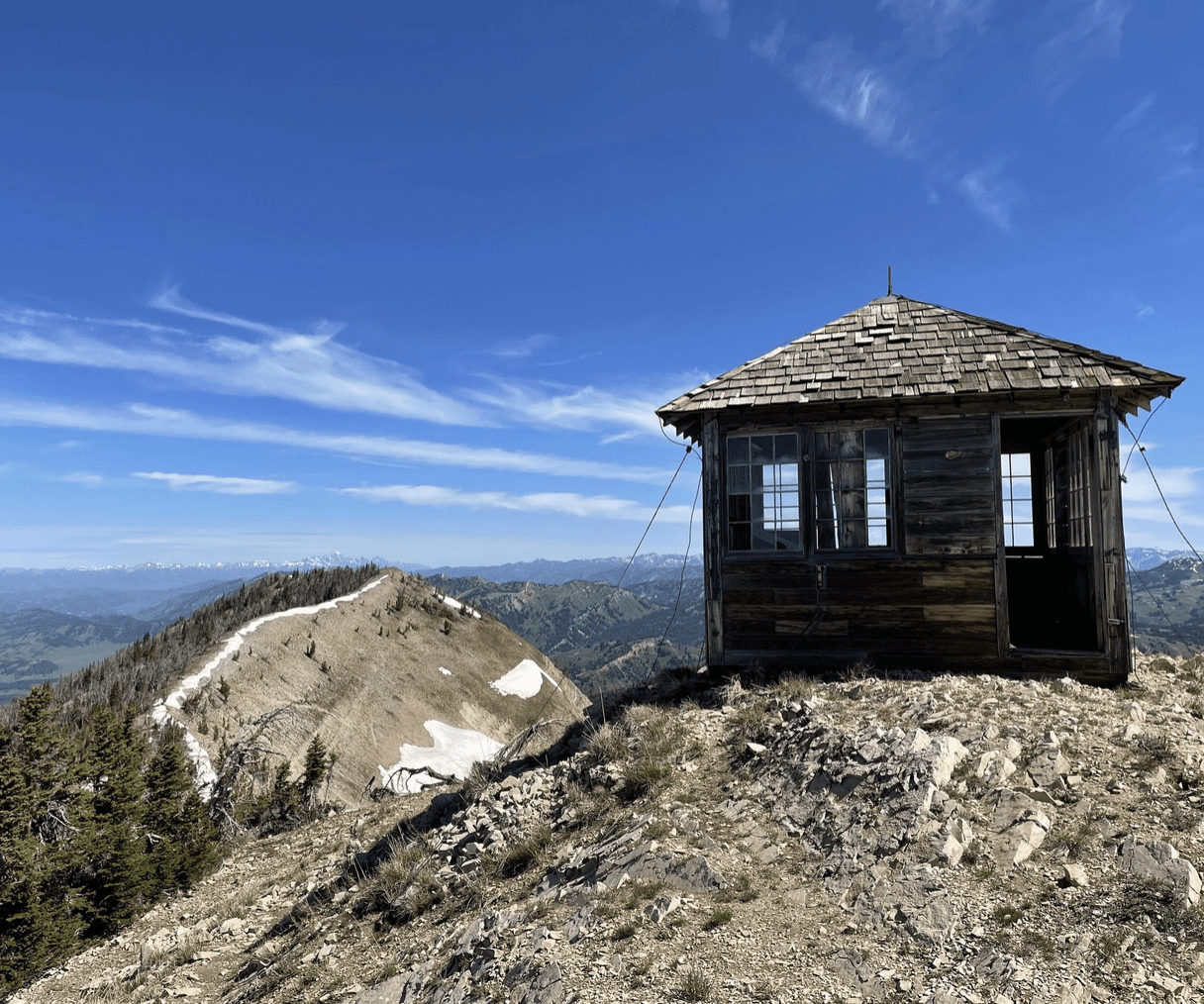
Wyoming Range 100 runners enter the Deadline Ridge Fire Lookout (shown here) at the end of stage 7. Originally built by the Civilian Conservation Corps in 1941, it been completely redone by volunteers from the Sublette County Historic Preservation Board—Certified Local Government.

Greys River District
This district takes its name from John Grey, a mixed race Iroquois and Scottish trapper in the area in the early 19th century. Grey is remembered in history (“history” being a road sign along Idaho Highway 362 in Caribou County) as a famed fighter of grizzly bears, and also a skilled intermediary between whites and Native Americans.
The district is 438,883 acres in size. Its tallest peak is Mt. Fitzpatrick, which rises 10,912 feet above sea level in the Salt River Range.
One of the district’s unique features is the only known cold water geyser in North America, the Periodic Spring. This spring is also unique because it is the largest of the three known fluctuation springs in the world.